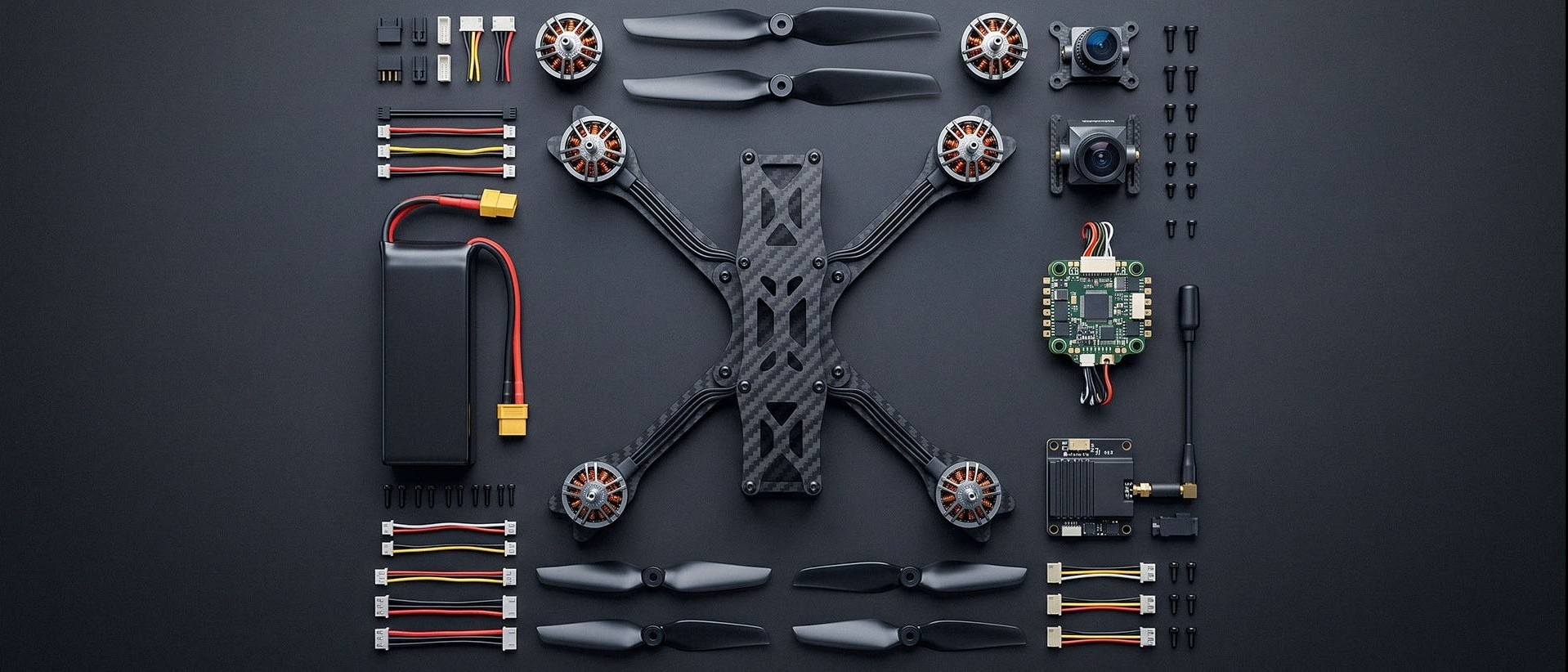
FPV drone component map: frame, motors, stack, video and power systems – parameter ranges for 5″–10″ classes and typical batch procurement mistakes
An FPV drone is made of seven core subsystems: the frame, the propulsion group with motors and propellers, the control stack, the video system, the radio control link, the power system and the antennas. By industry estimates, up to 90% of a finished drone's cost is FPV drone components – which is why a mistake at the batch specification stage costs more than any assembly mistake: an incompatible item cannot be fixed with a soldering iron, it can only be reordered. This map is for whoever builds the BOM (bill of materials) for a batch: seven subsystems with terminology, working parameter ranges for the 5″, 7″ and 10″ classes, the dependency chain behind component choices, and the mistakes that most often stop production.
Seven subsystems of one aircraft
Frame
The carbon fiber load-bearing structure: bottom and top plates, arms, standoffs. The frame diagonal in inches is the main classifier of the whole drone, because it physically limits the propeller diameter. For procurement, what matters is not only the size but also the mounting patterns for electronics (20x20, 25.5x25.5 and 30.5x30.5 mm standards) – this is where incompatibility is caught most often.
Propulsion group (motors and propellers)
Brushless motors are labeled by stator size (2207, 2807, 3115 – diameter and height in millimeters) and by KV – revolutions per volt with no load. The rule is simple: a bigger propeller needs a bigger stator and a lower KV. Propellers ship in pairs of rotation directions – two clockwise (CW) and two counter-clockwise (CCW); in a batch specification this is a separate line item that gets forgotten.
Stack (FC + ESC)
The computing and power core: the flight controller (FC) with a gyroscope, accelerometer and barometer reads the sensors and the operator's commands; below it, the electronic speed controller (ESC, typically 4-in-1) turns the controller's decisions into current for the motors. The two boards are mounted as one block on dampers – hence the "stack".
Video system (camera + VTX)
The FPV camera captures the picture; the FPV video transmitter (VTX) overlays telemetry (OSD) and broadcasts it to the operator. Cameras are classified by light sensitivity (daylight, low-light, thermal) and form factor (nano 14 mm, micro 19 mm); transmitters – by power output and by the type of video link, analog or digital.
Control link (RX)
The onboard radio receiver picks up commands from the radio and passes them to the flight controller. The de facto standard in Ukrainian practice is the open ExpressLRS (ELRS) protocol on 2.4 GHz or 868/915 MHz; the closed Crossfire ecosystem exists alongside it. The receiver's firmware version is a procurement parameter, not a detail – more on that below.
Power system (battery + PDB/BEC)
FPV batteries fall into two camps: LiPo delivers maximum instantaneous discharge – the choice for high-speed platforms; Li-Ion packs built on 21700 cells win on energy density – the choice for long missions. The configuration is written as 6S1P or 6S2P: the number of cells in series and in parallel. The power distribution board (PDB) and the voltage regulator (BEC) route energy to the subsystems.
Antennas
Separate for video (usually circular polarization) and for control (linear dipoles). An underrated subsystem: a powerful VTX without a matched antenna overheats and fails, and antenna connectors (MMCX, U.FL, SMA) are another classic point of batch incompatibility.
The dependency chain
Components are not picked as "the best from each category" – the choice runs as a cascade, where each step narrows the next:
- Frame defines propellers. The diagonal fixes the maximum propeller diameter.
- Propellers define motors. A bigger propeller demands a bigger stator and a lower KV – otherwise, overheating.
- Battery voltage defines KV. RPM roughly equals KV times voltage: the same platform on 6S and 4S needs different motors.
- Motors define the ESC and battery discharge. Peak currents of large motors require headroom in the ESC amperage and in the battery C-rating.
- Everything together defines the payload. Thrust minus the drone's own mass is what the aircraft will actually carry. Engineering guides put the minimum thrust-to-weight ratio at 2:1; maneuver-heavy tasks are planned at 4:1 and above, while heavy long-range platforms live around 3:1 with current headroom.
The practical takeaway for a buyer: a specification is always written from the task and payload mass backwards to the frame – not from a "good deal on motors".
Parameters by class
Working ranges as of August 2026, compiled from technical guides and catalogs; the exact configuration is always set by the technical specification.
| Subsystem | 5″ | 7″ | 10″ |
|---|---|---|---|
| Frame wheelbase | ~210-230 mm | ~280-320 mm | ~360-450 mm |
| Motor stator | 2207-2306 | 2506-2807 | 3110-3115 |
| KV (on 6S) | ~1700-2100 | ~1100-1500 | ~800-1200 |
| ESC (4-in-1) | 35-50 A | 45-60 A | 55-80 A |
| Battery | LiPo 6S 1300-1800 mAh | Li-Ion 6S 3000-8000 mAh | Li-Ion 6S2P-6S3P, 6000-12000+ mAh |
| Payload | up to ~0.5-0.8 kg | ~1-2 kg | ~2.5-4+ kg |
The ranges are indicative: sources differ depending on the mission profile (speed, long range, heavy lift), which is exactly why a technical specification fixes the full configuration rather than "a class in general" – how to do that is covered in our specification requirements checklist.
Four mistakes that cost a batch
Underrated ESC amperage. The most expensive of the typical mistakes: a controller bought "right at" the nominal rating burns out on the peak currents of a sharp climb – and the aircraft becomes uncontrollable in flight. For heavy platforms, current headroom is a requirement, not an option; along with the ESC, check for low-ESR capacitors in the kit.
Firmware version mismatch. ExpressLRS receivers with major versions 2.x and 3.x are incompatible with each other: a batch of a thousand "warehouse stock" receivers on the old version means hundreds of hours of manual reflashing before assembly. The same goes for the ESC firmware ecosystem (BLHeli_S, Bluejay, AM32) – old revisions cut off modern motor control protocols.
Physical incompatibility. Stack mounting patterns (20x20 vs 30.5x30.5 mm), battery power connectors (XT30/XT60/XT90), peripheral signal connectors (JST-SH vs latching JST-GH), antenna connectors (MMCX vs U.FL), motor wire lengths for a specific frame – at batch scale, each of these details turns into re-soldering a thousand items.
The illusion of a cheap entry. A budget calculated only on the cost of the aircraft forgets the periphery: radio controllers, goggles or ground stations, charging infrastructure, tools. For a batch this is not a detail but a separate budget line – without it, the aircraft are non-operational assets.
A view from the line. These four categories – amperage, firmware versions, connectors and mounting – are exactly what our incoming inspection checks in every batch of components before it reaches the workstations. A mismatch caught at the entrance costs a return to the supplier; caught during assembly – a line stop; caught at the flight range – a batch. That is why in our specifications the firmware version and connector type are mandatory fields, just like the stator size. – Chief Line Engineer, KRYLACHI
Analog, digital or fiber
The choice of video link is not just about picture quality – it is about different supply chains. An analog video system is the cheapest and fully cross-compatible between manufacturers: supply is easy to diversify, which for a series often matters more than resolution. Digital systems (the DJI, Walksnail and HDZero ecosystems) deliver dramatically better detail, but the kit costs several times more, weighs more and locks the batch into one ecosystem with no interchangeability – procurement becomes dependent on the availability of specific modules.
A fiber-optic link changes the economics the most. The spool is a consumable: the cable cannot be rewound, so it is a per-flight item, not a per-aircraft one. According to public price lists as of August 2026, spools cost roughly UAH 16,000-70,000 depending on line length (10-30 km), and weigh from about 1 kg for 10 km to about 2 kg for 15 km – which is why fiber configurations live on 10-inch and larger platforms, with the spool mass eating into the payload. Add a dedicated ground station with an optical interface. None of this is an argument "for" or "against" – these are budget lines that must be calculated before the contract is signed.
Frequently asked questions
What is a stack in an FPV drone?
A stack is a block of two boards mounted one above the other: the flight controller (FC) and the electronic speed controller (ESC, usually 4-in-1). The controller processes sensors and operator commands; the ESC turns its decisions into current for the motors. The boards have standardized mounting patterns – 20x20, 25.5x25.5 or 30.5x30.5 mm – and this size must match the frame.
What is the difference between a flight controller and an ESC?
The flight controller is the "brain": gyroscope, accelerometer, stabilization math. The ESC is the "muscle": power electronics feeding the motors on the controller's commands. In modern builds they are almost always bought together as a stack, and the compatibility of their firmware and protocols is a separate specification item.
Where do you start when selecting components for a batch?
From the task, not from the catalog: payload mass and required range define the platform class, the class defines the frame and propellers, those define the motors, and the motors define the ESC and the battery. Fix this chain in the technical specification together with firmware versions and connector types – and the batch will assemble without surprises.
Whether you already have the components or they still need to be sourced – we work with both scenarios: cost-plus procurement with no markup as a supporting service, and contract assembly of your batch to your specification.
Parameter ranges and prices are from open sources as of August 2026; the component market moves fast, and the specification of a specific batch is always confirmed at the time of order.
