The difference between a drone, a UAV and a UAS, plus a practical breakdown of drone types by design – from quadcopters and hexacopters to fixed-wing and VTOL – and by role
A drone is an aircraft that flies with no pilot on board: it is controlled remotely by an operator, by an autopilot along a route, or by both in combination. There is no universal drone – each type of design exists for its own class of tasks, and it is the type that determines how long the aircraft stays airborne, whether it can hover over a point and how much weight it can lift. Below is a practical classification: terms first, then types by design and by role, and finally how to choose a type for the task.
What is the difference between a drone, a UAV and a UAS
In everyday speech all three words are used as synonyms. In documents they are not.
Drone is the colloquial name for any unmanned aircraft; it almost never appears in technical or procurement documentation.
UAV (unmanned aerial vehicle) is the aircraft itself: the frame or airframe, the propulsion system and the onboard electronics. This is the term used in specifications and regulatory documents. The Ukrainian equivalent is БпЛА.
UAS (unmanned aircraft system) is the aircraft plus everything required to operate it: the ground control station, communication links, charging and support equipment. The Ukrainian equivalent is БпАК – and when Ukraine's Ministry of Defense codifies a product, it is usually the system, not just the aircraft, that gets codified.
The practical consequence for procurement: the contract and the technical specification must state exactly what is being supplied – individual aircraft (UAVs) or complete systems (UAS) – because the difference in scope is a difference in price and in what actually arrives at your warehouse.
Classification by design
Design defines the physics of flight, and physics defines the capabilities. The main split: multirotors (lift from rotors), fixed-wing platforms (lift from the wing) and hybrids.
Quadcopters
Four motors, four propellers – the most common scheme in the world and the most widespread in Ukraine's Defense Forces. The reasons are simple: the cheapest mechanics per unit of thrust, vertical takeoff and landing with no infrastructure, the ability to hover over a point, high maneuverability. The trade-off is energy efficiency: rotors keep the aircraft airborne through constant work, so flight time is limited by battery capacity and is usually measured in tens of minutes, not hours.
Hexacopters
Six motors. The extra rotors deliver two effects: higher payload capacity and redundancy – some models can complete the flight in a controlled way even after one motor fails. The cost: a larger frame, more mass, a more expensive power system. Typical use: lifting heavier equipment, and tasks where losing the aircraft costs more than two extra motors.
Octocopters
Eight motors – the highest payload capacity and redundancy among production multirotors. Used where the payload is heavy and expensive: professional sensor suites, laser scanning, specialized equipment. In the defense segment the scheme is rarer than quad- and hexa-layouts: for most tasks its advantage does not justify the price.
Fixed-wing UAVs
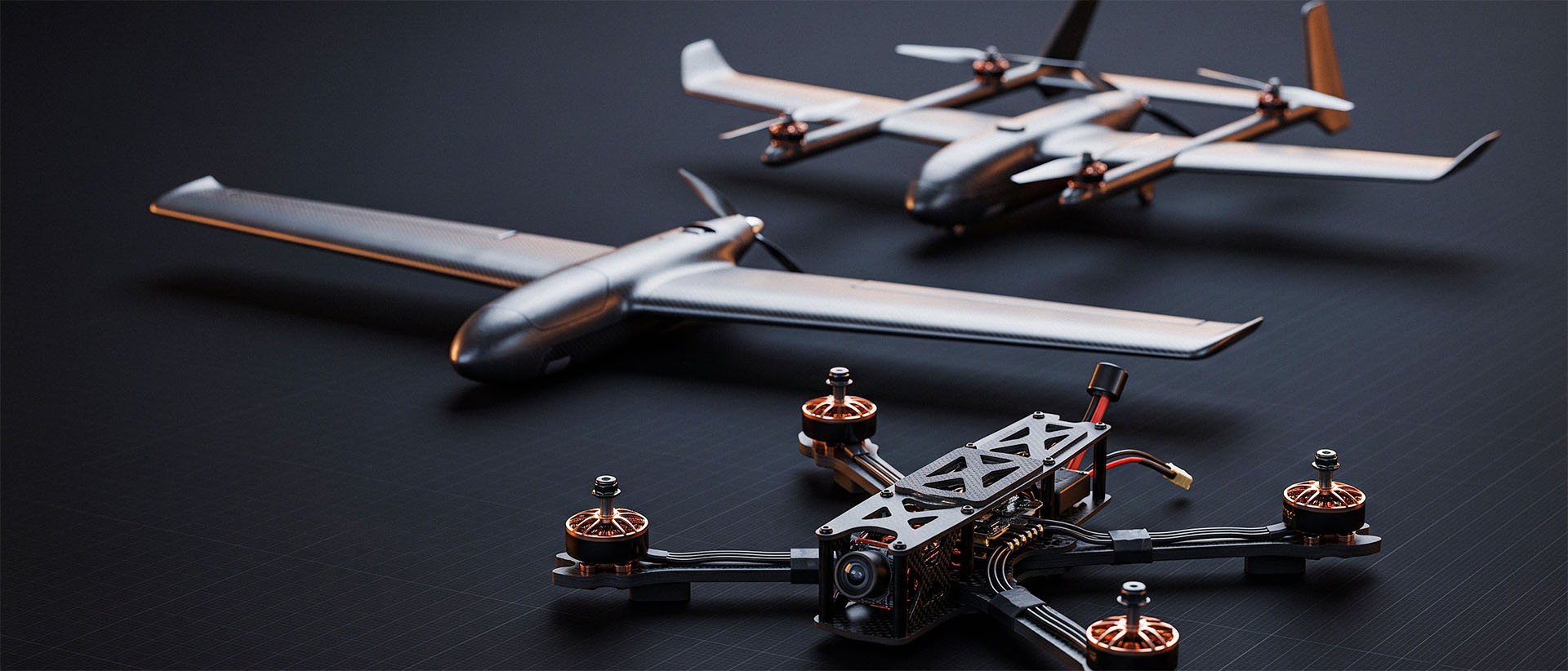
Fundamentally different physics: the wing creates the lift, the motor only pulls the aircraft forward. A fixed-wing platform therefore spends far less energy in flight and stays airborne for hours, covering large areas – the classic choice for reconnaissance, mapping and monitoring long linear objects. The limitations are the mirror image: the aircraft cannot hover, and launch and recovery require a runway, a catapult or a parachute system.
VTOL
VTOL (vertical take-off and landing) is a hybrid that combines both schemes: it takes off and lands vertically on lift rotors like a multirotor, then transitions to the wing for horizontal flight like an airplane. The result is fixed-wing endurance without the need for a runway. The price is structural complexity: two propulsion subsystems in one aircraft mean more mass, higher cost and more points of failure.
Where FPV fits in this classification
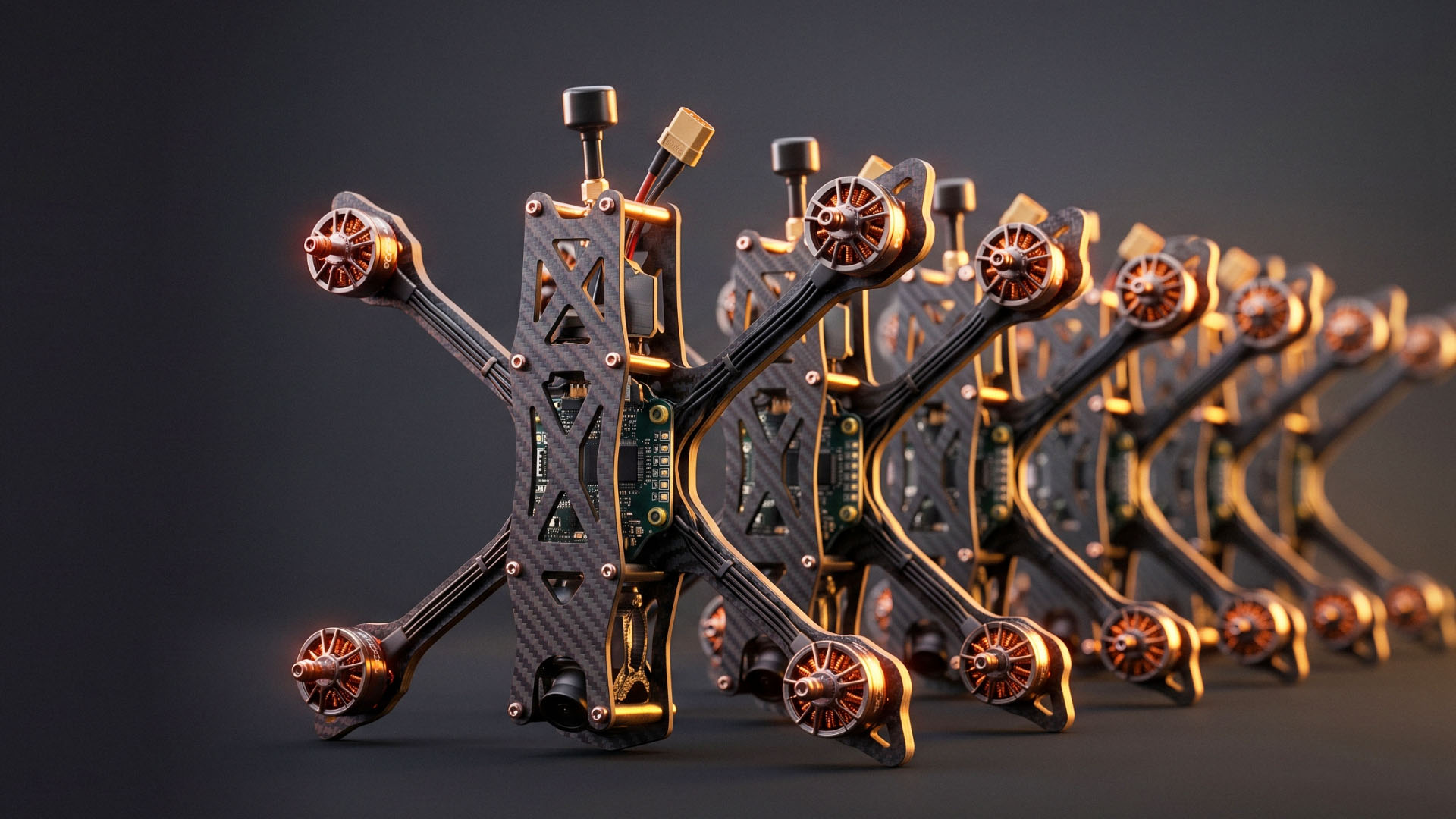
FPV is not a type of design. It is a control method (First Person View – the operator sees live video from the aircraft), which in Ukrainian practice has also become the name of a distinct class of combat multirotors. Structurally, a combat FPV drone is most often a quadcopter assembled to a specific technical specification. A full breakdown of the term, the build and the FPV classes is in a separate article: what is an FPV drone.
Comparing the types
| Type | Hover | Flight time | Payload capacity | Launch | Typical tasks |
|---|---|---|---|---|---|
| Quadcopter | yes | tens of minutes | baseline | hand launch / on-site | mass deployment, point work |
| Hexacopter | yes | tens of minutes | increased | on-site | heavier equipment, redundancy |
| Octocopter | yes | tens of minutes | highest among multirotors | on-site | expensive sensors, specialized equipment |
| Fixed-wing | no | hours | depends on the airframe | runway / catapult | wide-area reconnaissance, mapping |
| VTOL | yes (takeoff / landing) | hours | moderate | on-site | reconnaissance without infrastructure |
Classification by role
In the defense context, the design types map onto roles. Reconnaissance platforms are fixed-wing aircraft, VTOLs and multirotors with quality optics: endurance and a stable picture matter more than agility. Strike platforms are primarily FPV multirotors assembled around a specific payload. Logistics platforms are heavy multirotors delivering cargo over short distances. Relay platforms are high-altitude aircraft that extend the communication range for other drones. Interceptors – high-speed aircraft for countering aerial targets – are the youngest class. A detailed breakdown of combat FPV roles is in the article on FPV classes.
How to choose a type for the task
- Do you need to hover over a point? Yes – a multirotor or a VTOL. No, you need area coverage – fixed-wing.
- How long must the aircraft stay airborne? Tens of minutes – a multirotor. Hours – a wing or a VTOL.
- What is the mass and size of the payload? The answer defines not the type in general but the specific class within the type – and this is where the work on the specification begins.
- What launch infrastructure is available? No runway and no catapult – a multirotor or a VTOL.
The answers to these four questions are effectively the first section of a technical specification. How to expand them into a full spec for a manufacturer – in our specification requirements checklist.
Our line assembles multirotor FPV platforms from 5″ to 10″; fixed-wing builds are available on request. From a serial assembly perspective, different types – and even different classes within one type – mean different process sheets, different reference samples and different test programs: there is no universal "drone assembly in general", only the assembly of a specific configuration to a specific technical specification. – Chief Line Engineer, KRYLACHI
Frequently asked questions
What is a UAV in simple terms?
A UAV is an unmanned aerial vehicle: any aircraft without a pilot on board, controlled remotely or by an autopilot. "Drone" is the colloquial synonym, while a UAS is the broader concept: the aircraft together with the ground control station and the equipment required to operate it.
Why would a multirotor need more than four motors?
Six or eight motors provide higher payload capacity and redundancy: the aircraft can survive a motor failure. The cost is mass, price and complexity, which is why the quadcopter remains the mass-market standard, while hexa- and octo-layouts are chosen where the payload is heavy or expensive.
What is VTOL?
VTOL is a vertical take-off and landing aircraft: it takes off like a multirotor and flies like an airplane. It delivers fixed-wing endurance without a runway, at the cost of a more complex and expensive design with two propulsion subsystems.
Have a technical specification for a multirotor platform – we provide contract FPV assembly from a pilot batch to full series, with a client-approved reference sample and testing of every aircraft.